
DENTURES & PARTIALS — GREENWOOD FAMILY DENTISTRY Trenton, NJ
Dentures & Partials in Greenwood Family Dentistry: What Trenton Patients Should Know Before Getting Fitted
There’s a moment a lot of our patients describe the same way — chewing gets harder, certain foods get crossed off the list, and smiling starts to feel like something you think about instead of something you just do. You’re not stuck with it. Dentures and partials have come a long way from what your grandparents wore, and for most people the fix is more straightforward than they expect.
What Are Dentures & Partials and Why Do You Need Them?
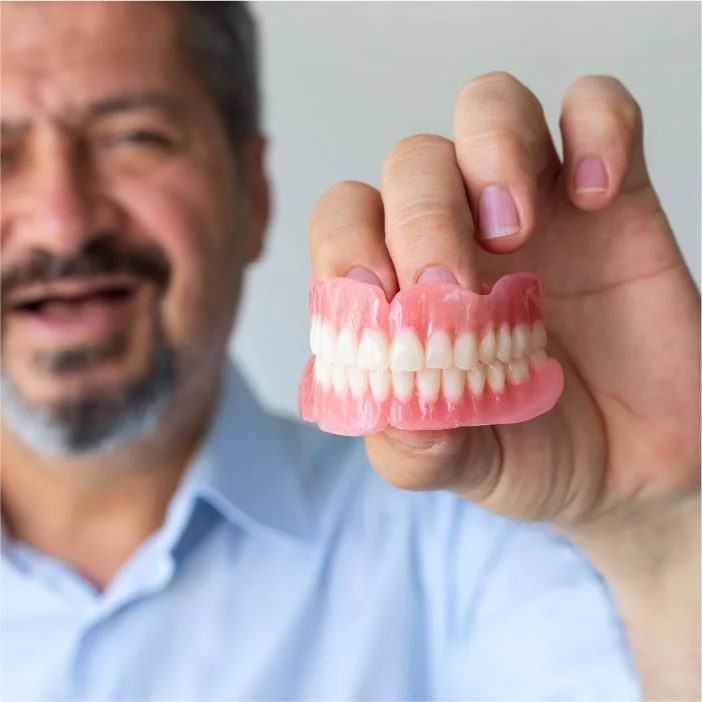
Dentures are removable replacements for missing teeth, custom-built to sit on your gums and restore the look and function of a natural smile. A complete denture replaces an entire arch, top or bottom, once all natural teeth in that arch are gone. A partial fills in gaps where some natural teeth remain, anchoring to those teeth with clasps so it stays put.
This isn’t a niche treatment. Current estimates put the number at around 178 million U.S. adults missing at least one tooth, and more than 35 million are missing all of their natural teeth entirely — about 90% of that group wears dentures. The need climbs with age, too: only around 3% of adults aged 18 to 34 wear a partial or complete denture, jumping to 16% by ages 35 to 44.
There is some good news. Edentulism — total tooth loss — affected nearly 19% of Americans in the late 1950s. By the early 2010s that had dropped to under 5%, largely thanks to better preventive care. Still, tens of millions need a denture or partial at some point, and Trenton is no exception.
Our Dentures & Partials Treatment Process

Consultation & Exam
We evaluate your gums, remaining teeth, and jawbone to determine the right type of denture for you.

Impressions & Measurements
Detailed molds and bite measurements are taken so your denture is built to fit your mouth specifically.

Fitting & Placement
Your custom denture is placed, checked for fit and bite alignment, with adjustments made on the spot.

Follow-Up & Adjustments
We schedule follow-up visits to fine-tune the fit as your gums settle — some adjustment early on is normal.
PATIENT EXPERIENCES
What Our Patients Are Saying
EXCELLENT Based on 20 reviews
 Posted on Google
 Jake PhillipsAlways easy to find an appointment and the staff are lovely and fast!Posted on Google
 Brett RobertsDr. Shariff is wonderful and sensitive to a patient's discomfort.Posted on Google
 Janio CardonaI’have been a patient of Greenwood Family Dentistry (1902 Greenwood Aven Trenton, Nj)for over two decades, and it’s truly been one of the best dental experiences I’ve had . Back when Dr Richard Nedelman owned the practice , he was an absolute professional- whether it was a routine cleaning, root canals,filling in different materials or any other dental treatment, he always did exceptional work.He was patient,skilled , and even offered flexible payments arrangements to make things more comfortable for his patients. It was incredibly care, and I trusted him completely. After Dr Nedelman got retired a few years ago I was a bit worried about the change,but the new owner, Dr Farad Shariff has been just as outstanding. She is an excellent professional who take her time throughoutly explain every procedure, answer all questions and makes sure you feel comfortable and informed. The entirely staff is efficient,friendly and very punctual- appointments start on time with almost no waiting time.If something comes up and you need to reschedule, they handle it courteously and work with you to find a better date and time.Overall the level of customer service and quality of treatments remains Top-Noch. Greenwood Family Dentistry is a fantastic option for anyone looking for reliable, caring Family Dental Care in the Trenton area. I highly recommend Dr Shariff and the team -A-Plus from me.Posted on Google
 Sarahi DLConvenient hours available if you have a busy life. Friendly staff and always willing to work with one around dental care needs. Thank you!Posted on Google
 Mark UVery professional and accommodating. Dr. Shareef and her staff are courteous and friendly. Dr. Shareef is very knowledgeable in her work and advice. I had 2 different procedures with her in the past few years, and both were very efficient and excellent. I'm very satisfied and would recommend her to anyone and everyone.Posted on Google
 Clifton GrimesDr. Shariff and her team are amazing! The staff are caring, friendly and knowledgeable, and they always make me feel at ease. Dr. Shariff is the best dentist I’ve ever been to, period! Her gentle manner completely removed my fear of dental visits (especially injections 💉💉). I’m so grateful to have found a dentist who truly cares about her patients! Highly recommended!Posted on Google
 Jay DunnThe dentist always cares about the patient's well being.Posted on Google
 shania roseVery clean and peaceful environment. The staff was very pleasant and welcoming. The wait time was not long which I’m thankful for. After my service was done I was informed about possible problem areas and how they could be addressed so that gave me peace of mind. Overall 10/10 experience.
FAQ's
Frequently Asked Questions
Most people need anywhere from a few days to several weeks. It's common to notice minor discomfort, some difficulty speaking clearly at first, and a learning curve with eating. This settles down as your mouth adapts. Regular follow-up visits with your dentist make the transition smoother and catch fit issues early.
A systematic review published in the Journal of Prosthetic Dentistry found that complete dentures last an average of about 10 years, though many patients need adjustments well before reaching that point. In practice, most dentures need relining or replacement somewhere between 5 and 10 years, depending on jawbone changes and how well the denture is cared for. They don't fail all at once — they lose effectiveness gradually.
The main reason is bone resorption. Once a tooth is removed, the jawbone underneath no longer gets the chewing pressure that kept it strong, so the body gradually breaks it down. Research published in the Indian Journal of Dentistry found that up to 25% of the surrounding bone can be lost in the first year after extraction alone, with the most dramatic loss happening in the first three to six months. A denture that fit perfectly at first can start to feel loose over time — it's not a defect, it's biology.
An immediate denture is placed the same day your teeth are extracted, so you're not without teeth while your gums heal. It's a transitional appliance, not a long-term solution. Bone remodeling after extraction typically takes six months to a year, sometimes up to eighteen months, and the fit will change as healing progresses. Most dentists recommend transitioning to a permanent, custom-fit denture once healing has stabilized — usually six to twelve months out. Keeping an immediate denture long-term often leads to a poor fit, faster bone loss, and a sunken facial appearance.
Two stand out. The first is waiting too long to address tooth loss, which allows more bone resorption before treatment even starts. The second is ignoring a loose or ill-fitting denture instead of getting it relined or adjusted. A poor fit doesn't just cause discomfort — it distributes chewing pressure unevenly, speeds up bone loss, can create sore spots on the gums, and often pushes people toward over-relying on denture adhesive instead of getting the fit actually corrected.
It tends to snowball. Reduced chewing function can affect nutrition over time, and sore spots on the gums become more frequent. The uneven pressure accelerates the very bone loss that caused the looseness in the first place, which over time can change the shape of your face — a sunken appearance is a common long-term sign of unaddressed bone resorption. Most dentists recommend a reline every one to two years to stay ahead of this, since relining is far simpler and more affordable than waiting until a full replacement is unavoidable.
A common concern on Quora is a "blue hue" or translucent appearance post-whitening. This happens temporarily because the tooth enamel becomes slightly dehydrated during the chemical process, causing it to reflect light differently. Once your teeth naturally rehydrate over the next 24 to 48 hours, their opaque, solid white appearance will fully return.
Retail kits use a "one-size-fits-all" approach. Generic trays allow bleach to spill onto your sensitive gums, causing chemical burns. Furthermore, retail laws restrict the strength of over-the-counter whitening agents. You end up paying for a weaker product that takes weeks to show minor results, whereas professional treatments offer customized protection and dramatic, immediate shade transformation.
Reddit's r/Dentistry and r/Anxiety communities are full of patients who feared fillings and were surprised by how manageable the experience actually was. Common themes: the anticipation is worse than the procedure, topical numbing gel made the injection nearly painless, and the dentist's communication style made a huge difference. Many users also share regret about delaying treatment, noting that the cavity worsened and became more expensive to fix. The consensus: just go. It's easier than you think.
Early-stage enamel erosion — called a "white spot lesion" — can potentially be remineralized and halted with fluoride treatments and improved oral hygiene before it becomes a true cavity. However, once decay breaks through the enamel surface and creates a hole, it cannot heal itself. Saliva and fluoride cannot fill a physical gap. At that point, a filling is necessary. Waiting only allows the decay to progress deeper and become more complex and costly to treat.
Waiting too long. The most common and costly mistake is ignoring early symptoms — mild sensitivity, a slight toothache, a visible dark spot — hoping they resolve on their own. They won't. Every week of delay allows decay to penetrate deeper, increasing the chance that a simple filling becomes a root canal, a crown, or even an extraction. The second biggest mistake: skipping follow-up appointments to check how a new filling is settling. Your dentist needs to verify your bite alignment and ensure the restoration is holding up.
Not always. For baby (primary) teeth, dentists often use tooth-colored composite or stainless steel crowns rather than the same materials used in adult teeth, since baby teeth will eventually fall out. Glass ionomer is also common for pediatric cavities because it releases fluoride and bonds without requiring as dry an environment as composite. For permanent teeth in children and teens, the same options available to adults apply. Treating cavities in baby teeth is still important — untreated decay can cause pain, infection, and affect the development and eruption of permanent teeth.
Your smile is worth protecting. Schedule your appointment today.
We serve patients from Trenton, Hamilton Township, Lawrence Township, Ewing, Princeton Junction, and the surrounding Mercer County area.
- 609-587-6670
- info@greenwoodfamilydentistry.org
- 1902 Greenwood Ave. Trenton, NJ 08609
- Our Hours: Open Weeknights and Weekends